
End-of-Life Pathway with Nurse Next Door
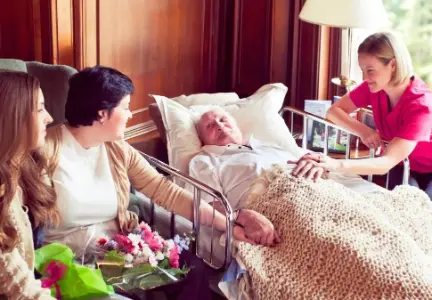
Many older Australians wish to remain in their own home, surrounded by family and familiar comforts, as they near the end of life and the Support at Home End-of-Life Pathway makes this a possibility.
Designed for people with an expected life expectancy of 3 months or less, the End of Life Pathway provides up to $25,000 in dedicated funding for additional in-home care support.
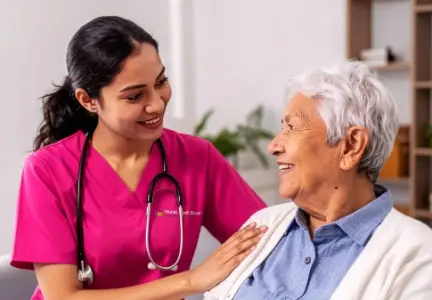
Nurse Next Door can support you and your family with compassionate end of life care at home, delivered with dignity, respect, and a calm, consistent plan, enabling you to live life your way, right to the end.
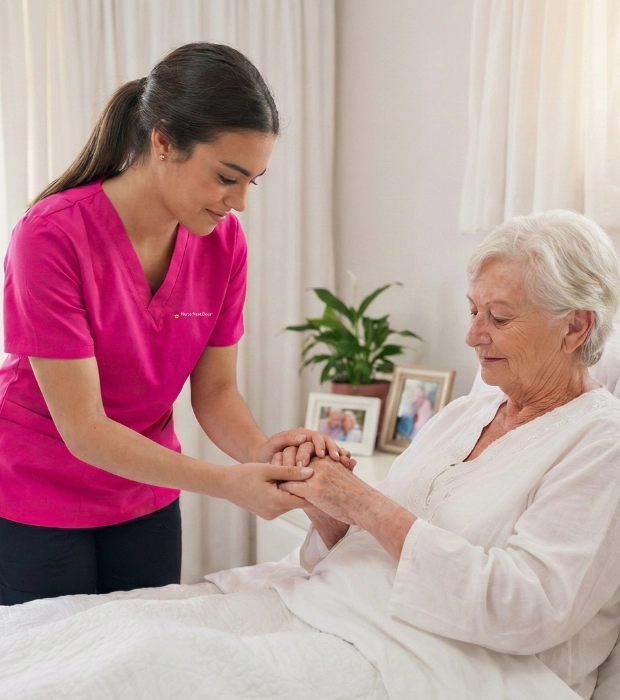
We Respect
What Matters to You
End-of-life care is not only physical, it’s emotional, relational, and deeply personal. We take time to understand your goals, values, and what dignity looks like for you, so care feels respectful and truly person-centred.
Our role is to help create calm in a difficult time: supporting comfort, reducing stress, and making space for meaningful moments. We can also help your family feel supported and informed, encouraging open, gentle communication as decisions arise.
Above all, we honour your individuality, your choices, your culture, your beliefs, and your right to be cared for in a way that reflects who you are.
Our End-of-Life Pathway Services
Your Care team can provide a range of supports to help you remain at home, with comfort and dignity.
Services are based on your approved plan and align with Support at Home categories. The pathway can fund extra supports such as: Personal care (e.g., showering, dressing, toileting), Domestic assistance (e.g., cleaning, laundry), Meals and meal preparation, shopping and daily routines, Transport, Respite Care and Clinical Supports such as nursing care, plus allied health like OT and physiotherapy where appropriate
Nurse Next Door will put your needs first, so you can spend more time together.
Support Where and
When You Need It
Needs can change quickly at the end of life. Our goal is to respond with the right care at the right time, without delays, confusion, or unnecessary handovers.
We work in close contact with your broader health team to support smooth care coordination and a consistent plan at home. If services need to increase, we can adjust quickly and thoughtfully.
Most importantly, you will never feel alone. Your Nurse Next Door Care Team is here with steady, compassionate support, helping you and your family through each day and night with comfort and peace of mind.
Devoted & Experienced
End-of-Life Support
When a loved one is nearing the end of life, everything can feel urgent and overwhelming. Alongside the emotional weight, there are practical decisions to make, what support is needed right now, who will help day-to-day, and how to keep care consistent as needs change.
That’s where we come in. Your Nurse Next Door Care Team works closely with you, your family, and your treating health professionals (including your GP and palliative care teams) to coordinate support that’s calm, respectful, and responsive.
The End-of-Life Pathway is designed to complement state and territory palliative care services (it doesn’t replace them), helping ensure practical supports are in place at home while specialist teams focus on comfort and symptom management.

Clients accessing state funded palliative care
The End of Life Pathway works alongside state funded palliative care, so you may be able to access both at the same time if eligible. The End of Life pathway is designed to complement, not replace, state services which handle specialised symptom management. They run in parallel to provide comprehensive support.

Clients WITH an existing Support at Home plan
A doctor or nurse practitioner must complete the government's End of Life Pathway form to confirm a prognosis of less than 3 months to live. Your provider must then request an urgent Support Plan review to transition you to the End of Life pathway. As soon as this funding is approved the additional care can be provided.

Clients WITHOUT an existing Support at Home Plan
A doctor or nurse practitioner must complete the governments End of Life Pathway form to confirm a prognosis of less than 3 months to live. You must then request a high priority assessment from My Aged Care by calling 1800 200 422 or applying online. Once the funding is approved you can contact Nurse Next Door to arrange starting services.
Helping you to Understand



Frequently asked Questions
What is the Support at Home End-of-Life Pathway?
It’s a short-term, high-priority Support at Home pathway that helps eligible older people with 3 months or less to live access additional in-home aged care services to support them to remain at home (if they choose).
More information is available on the Support at Home page.
How much funding is available, and for how long?
Around $25,000 over 12 weeks, with the ability to use remaining funds for a total of up to 16 weeks.
Who is eligible?
Eligibility must be confirmed by a doctor or nurse practitioner, including:
- Age - 65+ (or 50+ for Aboriginal and Torres Strait Islander people)
- Life expectancy of 3 months or less
- AKPS score of 40 or less
What is an AKPS score?
AKPS (Australian-modified Karnofsky Performance Status) is a clinical tool used to describe someone’s functional status (how much support they need for daily activities). Eligibility requires a score of 40 or below. A score of 40 is commonly described as being in bed more than 50% of the time (which can also mean “in a chair”).
What services can the pathway cover?
The same types of services available through Support at Home, clinical supports, independence supports, and everyday living supports (e.g., nursing, personal care, cleaning, meals, transport, respite), based on your approved plan.
Does the End-of-Life Pathway replace palliative care?
No. It’s designed to complement state and territory palliative care services, helping bring extra day-to-day support into the home.
Can the End-of-Life Pathway be used more than once?
My Aged Care notes the End-of-Life Pathway can only be used once.
Will there be any costs?
Participants contribute to independence and everyday living services (based on income/assets). Clinical supports (like nursing) are fully funded by the government (no contribution).
Can the funding be used for equipment or home modifications?
My Aged Care notes your plan may include a separate budget for assistive technology (products and equipment). The Department also states participants may access some assistive technology funding but cannot receive funding for home modifications under this pathway.
Where can we get independent help if we have concerns?
The Department fact sheet notes you can contact the Aged Care Advocacy Line (OPAN) on 1800 700 600 for free, confidential support.
Real People, Real Impact
.webp)
.webp)
.webp)
.webp)
.webp)
Delivering a WOW Customer Experience
Nurse Next Door have been working with my son for the last few months, the care and support the support workers show him is of a high standard. The support worker we have regularly is reliable, kind, warm and best professional . Katie and felicity are professional and have clients and their families at the centre of everything they do. Highly recommend them

Kasey G
A great service. I enjoyed the initial caring interview and felt very confident about the services offered. This has been borne out in practice, and I am so pleased I chose "Nurse Next Door". My nurse has been so caring and helpful.
Gary Wert Senior
Keir and her team have very diligently cared for my very dear friend every day for months. I couldn’t ask for a more responsive and caring team. I’ve met a lot of service providers in my time and this team is the best! Great communicators always putting the client at the centre of what they do. Thank you-it’s such important work you do.
Sue Gillieatt
My dear 43-years-old, NDIS pensioner son, has been a client of Nurse Next Door (NND) in Melbourne CBD since 2021. NND has been a wonderful care agency for him in that time. The different NND Carers he has had in these 3 years have generally been excellent for him — On time, disciplined, hard-working, interested, sensitive, supportive, and friendly. NND managers and administrative staff have also been very efficient, effective and most helpful, supportive and respectful in their interactions with us, particularly in their planning, organising, and clear and frequent communication. I highly recommend NND to other people in Melbourne (and elsewhere in Victoria) who may need excellent welfare care for themselves, or family members or friends, in future !
John Austin
Nurse next door have been absolutely fantastic in supporting our dad. He needed care post surgery and not only was it provided by Nurse Next Door, but it was done with so much care, attention and gentleness. Highly recommend!
Shradha Somaia
NND is such a supportive and welcoming environment! I am proud to say i am apart of the Next Next Door team and get to experience first hand how dedicated the organisation is to ✨ making lives better! ✨ The GENUINE care provided to clients is truely exceptional 🩷
Carla Villella
Keir and Amanda made starting Mum on a Home Care Package easy and there was never any pressure. Great communication, wonderful support workers and always responsive - thank you!!
Kate Bullow
Would highly recommend this service. Our experience was beautiful and thank Nurse Next Door for their support during this difficult time.
Carla Hand
Shalini from Nurse Next Door has been absolutely incredible in her role as a Diabetes Nurse Educator. Her dedication to client care, especially in ongoing diabetes monitoring, is truly commendable. She consistently responds quickly to any concerns, ensuring timely support and guidance. Her approach is not only professional but also deeply patient and compassionate, making clients feel heard and supported. Shalini’s expertise in diabetic education has made a significant impact, and her responsible, proactive attitude is a true asset to the team. We’re very fortunate to have her involved in our clients’ care.
Ellen
Best service in town, more than supportive and couldn’t recommend them enough
Ellie Ryan
Nurse next door have been so easy to deal with from the first phone call when we were in desperate need and have continued to provide the same standard of care months on. The carer provided is the perfect match for my Dad and is always interested in listening to what dad has to say, she is so helpful and caring in all aspects. I can also say that about any temporary replacement carers that have been used as well. There were a few hiccups with our home care provided and Nurse next door dealt with all that as well. I would highly recommend NND to anyone needing care for the elderly loved ones.
theo pilipasidis
I cannot say enough how amazing Keir and her Team of Nurses are. I support Participants on the NDIS, and it is so hard to find providers who are genuinely passionate about what they do. Nurse Next Door are one of the best Nursing supports that I have worked with in the Disability Sector. They really do care about the people they support and are very proactive. Amanda is amazing, she is supporting one of my Participants, who was constantly in and out of hospital as he didn't feel confident in his previous Nursing Supports. Since meeting Amanda, this young man hasn't been to hospital in almost 3 months, he has built up a great relationship with Amanda, which shows how much he trusts her. His mum has been able to step back and not play Nurse, she also couldn't be happier with the impact this has had on her son's health. Meeting Nurse Next Door and introducing Amanda to this young man, has improved his quality of life in a big way. Thank you to Keir and Amanda for all that you do, you really are Angels :)
Sapphire Webster
Our family has used NND Newcastle for the last 3 years - whilst Mum was at home for in-home care and then into her transition to nursing home care. The care has been fantastic, it has enabled Mum in so many ways to continue to enjoy life whilst her abilities decline. Staff are warm, professional, adept at managing new situations and communicate back any concerns promptly. They have been our salvation knowing Mum has extra attention in facility care. Highly recommend.
Pip O’Brien
Mother With dementia nurse polite and treats mam with respect and dignity. Gives myself advice and tips to help me help my mother get through hard days and night s. Happy to have nurse next door helping mother and me
Stevie Todd
I love working for Nurse Next Door Hobart East, it gives me a good life/work balance, we have a great support network and we can really make a difference for our clients.
Diana Roberts
Our family has very recently engaged the services of Nurse Next Door to assist with providing some respite and personal care for my elderly father who has Parkinson's disease and Dementia. This introduction has enabled some time for my elderly mother to have a break from dad. Mum is very keen to keep at home as long as possible and the Nurse Next Door has services to accommodate this. From our initial contact with Daphnee through to carers providing services, our family is very happy.
Janet Shepherd
Nurse next door are Caring and Compassionate. A peace of Mind . And Wonderful lady cames out helps me with ADLS.
Debbie Dufour
I use Nurse Next Door Home Care Services Brisbane South West to assist myself and family in caring for my elder brother who has advanced MS and Dementia. Their willingness to communicate on all matters relating to Robert’s care is reassuring and supportive. The staff I’ve interacted with either via phone, email or in person are warm and nurturing and maintain a clear and present focus on the welfare of the people in their care and their families.
Jonathon Denman
Fiona and her team were easy to engage with. Furthermore, their client care and customer service were par excellence!
Francisco Martin
Professional, very capable, qualified and friendly staff. The best care available in my opinion after three years of great service. I thoroughly recommend the Nurse Next Door team.
Craig Warner
Caring compassionate professional gentle with good assessment and communication skills Very positive experience
Rose McEwin
We are incredibly grateful for the care and support our elderly Mum receives. The team is always friendly, kind and professional, treating her with genuine respect and compassion. What stands out is the way they encourage Mum to maintain her independence while providing support whenever she needs it. This has given her confidence to continue living in her own home, knowing she has caring people there to help. The staff consistently go above and beyond, communicating well with our family and ensuring Mum’s wellbeing is always the priority. It gives us peace of mind knowing she is in such capable and caring hands. We highly recommend this service to anyone looking for an aged care service that truly values dignity, independence and personalised support.
K G
How can I ever thank your company enough. A last minute trip to Melbourne, Nurse next door came to our rescue and were able to accommodate for our son, at the last minute (my fault). I have never used an agency before for my son A seamless, caring and professional service. Nothing was ever too hard. From the initial phone call, through to the accounts, it was so easy and faultless. Our nurse was so caring and professional, she made my son happy and safe. Thank you!! Our trip would have been a nightmare without you.
Fred Finette
Nurses Next Door are fantastic. The team is caring, professional and always go above and beyond. They treat everyone with dignity and kindness and their support makes a stressful time so much easier. Highly recommend Nurses Next Door. Margaret A
Margaret Azzopardi
Competent and excellent nursing services
John Rileigh
I cannot recommend this service highly enough they are the most helpful and excellent people I have ever met. From their services and staff, they go above and beyond to make you feel welcome and comfortable
Jill Davis
Have had two nurses from NND at home to dress a leg wound for several weeks, Excellent, professional staff. Proved a great help to me for dressings I could not do due to personal frailties. I would recommend them, anytime.
John Galanos
We are so grateful for this wonderful service. My Dad recently broke his leg and was unable to weight bare. Nurse Next Door Macarthur helped us out with very short notice. They came every morning for a month and helped my Dad shower, gave medication and sorted out everything around his home for the day. The staff were all wonderful, however, a special mention to Daphne who went out of her way to check in and visit regularly to ensure everything was going well and to my Dads most frequent Carer, Jasmine. At 79 years old and a quiet man, Jasmine made my Dad feel very comfortable and secure. This wonderful service allowed me to keep working during my Dads convalescence but more importantly helped my Dad feel happy each day so he could get on with his recovery. Thank you doesn’t seem enough. I would thoroughly recommend Nurse Next Door Macarthur.
Debbie Pope
I signed up with Nurse Next door Macarthur after learning about them from visiting and expo. From the first phone call it was clear to see that they had my best interest at the forefront. Yijiah and Daphnee have been amazing with linking me with the most amazing carers! They are kind, caring and always looking to do more to support me in the home. I appreciate everything they do. Yijah and Daphnee are always available to answer questions or any queries to I have with regards to my support needs. I highly recommend Nurse Next door Macarthur.
Betsy Ruiz-Monar
Nurse Next Door is a valuable company for our aging population and district in general. This team employs experienced carers that, in my family's time of need, helped to facilitate a diagnosis that was crucial to our loved one. This enabled us to prepare treatment. Nurse Next Door are providers as well as carers, which makes the administration of care easier on the family. This is a relief when navigating the confusion involved with understanding what is available for the level of care required. Our family member was specifically diagnosed with a disease which ensured further funding was sourced so that they may stay at home to feel secure. Our experience was beautifully managed with this company. End of life care is a particularly challenging time for the people involved. Nurse Next Door were there every step of the way. I can't recommend or thank them enough. In memory of Mum XO
Marni Hine
I had the privilege of working with some of the team from Nurse Next Door in the acute setting and now again in the community. Incredibly the team are able to transition hospital level care to very complex situations at home. It has been nothing but a positive experience and all of the clients I have worked with alongside Nurse Next Door have received top quality and patient focused care at home. Well done!
Zoe Linke
Nurse Next Door and Amandeep especially are so compassionate, understanding and supportive. But not only that, she goes above and beyond for a Support Worker Manager, ensuring that all our Support Workers are the best fit for our family, personally ensuring that they feel equipped to work positively with us exactly where we're at. We are an entirely Neurodivergent, PDA AuDHD family, with some extra areas of support needs and the Support Workers along with Amandeep all show extra care and understanding into our lives, making things so much better. I couldn't honestly know how I'd have survived the past year without their support and being just a text message away from that has been truly love saving in so many ways. You couldn't find a more compassionate, knowledgeable, lived experience person!
Cheryl Slade
The Nurse Next Door Adelaide South West Team are Amazing! I cannot reccommend them enough! When Mum's Package finally came through Anthony, Sally & Jo made appointing them her provider and beginning her services so easy and seamless. There was just kindness and ease. Being an only child, Mum has become more reliant on me as she has got older and had more health issues which have caused her to slow down and have more restrictions on what she used to be able to manage. The Wonderful thing with Nurse Next Door is they match their carers to their clients well and Mum has two lovely carers who come twice a week and she loves them. They take her to appointments, shopping and on all sorts of outings and sometimes just stay with her at home and help her with tasks she needs some help to acheive. Another Benefit is she also can get 3 light and easy meals a week which helps her and makes it that she has less meals preparation to do which the careers are available to help her with anyway. The flexibility of the the visits to be added or moved slightly when she has appointments is amazing. Belinda and Sheree show such care and consideration for mum and time spent with them builds her spirits and give her purpose. She has also had the addition of Mandy filling in when the other girls aren't available and Mandy is such a joy and really has a good laugh with mum's and keeps her spirit young at heart. Belind G has also joined her team for extra household cleaning and maintenance that mum cannot manage on her own anymore. I also cant thank Kerry enough for filling in while mums regular girls were away. It warms my heart to see that she is now feeling more independant of me and has her own self worth and purpose the team make her feels so supported to stay in her own home. Thanks so much for the ongoing support from the Nurse Next Door Adelaide South West Team. We look forward to a long relationship of care for mum. Deirdre Dixon on behalf of Rosemary Dixon.
Deirdre Dixon
I have been using Nurse Next Door for over a year now. Firstly for my husband who has dementia. Then for myself. I feel very cared for by the whole Care Service and would recommend them to any one needing help and support.
Annette pollard
I met matt through a business group, and from the start, I could see how passionate he was about helping people in need! I wouldn't hesitate, and have recommended Matt!
Matt Sloane
I highly recommend Nurse Next Door for their exceptional service. Keir is a fantastic communicator who listens and ensures that all concerns are addressed. She conducts detailed assessments to fully understand client needs, tailoring care to meet those specific requirements. Thank you for your dedication!
Mirna Gudka
I recently had the sad experience of visiting a friend who was receiving end of life care from "Nurse Next Door" in Woolgoolga. Agnes and her team of amazing carers went way beyond what I myself could ever provide someone in this situation. The care and patience given to my friend was something I will never forget. If you have anyone who needs special care for a loved one I cannot recommend these wonderful people enough. Thank you to every one of those who cared for Carmen. Judy McLachlan
Judith McLachlan
Working with Nurse Next Door was a great experience. They were friendly and clear in what they needed for their vehicle wrap, which made the whole process smooth. It's a breath of fresh air to deal with a company that's both professional and pleasant. We're sure their clients are receiving the same level of excellence and professionalism as well. Cheers for being awesome to work with!
Vinyl Wrapz
Donna is a absolute diamond very happy with the service and support she has given
Jean Avril
Nurse Next Door East provides exceptional care and support and goes above and beyond to provide outstanding care for my loved one. My uncle is not just a client but a person who has interests, family life, connections to the community and Nurse Next Door East ensures that he can still enjoy life with their support. Nurse Next Door East provides a wholistic approach not only supports in the home but also with health. Petra and Sarah are both nurses and it is reassuring for me to know if my uncle is unwell the carers will flag this with Petra and Sarah then a follow up visit is done. I live 2.5 hours away so this gives me peace of mind. Communication is honest and super prompt and it doesnt matter what time of the day I contact, I will always get a very prompt reply or phonecall. Nurse Next Door East not only supports our loved ones needing care but also the family. Words cannot express how how appreciative and happy we are that you are all involved in our lives. My uncle has a fabulous team around him to ensure he can live his best life. Thank you for what you do and who you are.
tanya eversham
A Massive Thanks to the Tim and Clinical Manager Danni for their support with an urgent nursing matter. The team at Nurse Next Door Home Care truly care - I would give 10 stars if I could!! Thanks Again!
Kate M
Head Nurse Sruthi and the whole team go above and beyond for their consumers. I’ve worked with them closely over the last few months with a rural consumer and their attention to care, communication & follow up has been phenomenal. I would recommend them to anybody, thanks again for all your hard work and help.
Rachel Beattie
"I have found Nurse Next Door - Hawkesbury is always efficient and provides prompt service. NND - Hawkesbury team have excellent and clear communication and have great reporting procedures. Staff have a genuine care for clients and quick to identify and report risk when needed. I found NND are always reliable and able to deal with complex situations. A pleasure to deal with under all circumstances and challenges."
Victoria Lillie
Nurse Next Door Home Care Services has been a wonderful inclusion and integral part of my mother's goals to remain independent in her own house while she works through her medical condition. The team of nurses lead by Cheryl have been amazing both professionally and personally. Updates and reviews have been instrumental in being able to address events in real time all without having to worry or stress my mother. Now having been backed by NDIS funding we are able to have more support from the team to help my mothers journey for independence and normality.
Aaron Cavanagh
I cannot recommend this company enough, my care has been exceptional and am super grateful for all they have done. They are the only nursing home care who were happy and willing to access my infusaport. The nurses, in particular hannah and lily, are so caring, bubbly and lovely.
Jess Hay
As a Support Coordinator, I meet so many providers — but every now and then, a team comes along that genuinely restores your faith in what caring for others should look like. Nurse Next Door has been one of those rare experiences for me. Their support workers don’t just “complete tasks.” They show up with heart. I’ve seen them bring comfort on the hardest days, celebrate the small wins, and treat clients with a level of gentleness and respect that can’t be taught — it has to come from real compassion. They communicate openly, listen deeply, and never make participants feel like a number on a roster. Instead, they make people feel safe, valued, and truly seen. For families who have struggled to find consistency or kindness in care, Nurse Next Door has been a breath of fresh air. Watching how they walk alongside participants — especially those with complex needs — has reminded me why I chose this field. Their dedication doesn’t just support clients; it brings peace, dignity, and moments of joy back into people’s lives. 💗 I wholeheartedly recommend Nurse Next Door to anyone needing support that comes from a place of genuine care and humanity.
Linda Jones
"Mum was smiling when we returned home and Wendy was able to easily chat with us and let us know how the afternoon/evening progressed" (1/12/23)
andrew duggan
Nurse next door has had a dramatic impact on my life. The staff are caring, kind and always ready to help. Over the last few months this has enabled me to work at improving my health situation with the support of Nurse Next Door. It is wonderful to know that they are always available to help. I would recommend Nurse Next Door to anyone who needs support with their situation.
Margaret Warby
"Nurse Next Door Adelaide South West have gone above and beyond for the care of our mum and dad. Staff are so caring, consistent and reliable. Has made a huge difference to our lives. "
Susan
I got lucky when I found Nurse NextDoor. The team they have wrapped around me are professional, gentle and caring and bring a spark to my day when they arrive. Nothing is too much to ask, and to be able to speak with your team, not a call centre, is massively reassuring. Well done team, and thankyou.
Julie Hays
The Caring Journal
The Caring Journal is your go-to destination for stories, insights, and resources that celebrate the art and heart of caregiving.



Why Nurse Next Door?

Quality Home Care That’s Personal and Professional
Every Care Plan is thoughtfully crafted, and every Caregiver is meticulously chosen to meet your needs.
Quality Home Care That’s Personal and Professional

We Match You with Your Perfect Caregiver
We hand-pick the right person from our trusted team of Caregivers based on your needs, preferences and personality.
We Match You with Your Perfect Caregiver

Reliable Care with Our Attendance Monitoring System
Our activity monitoring system closely monitors every visit to ensure Caregivers arrive on time and schedules run smoothly.
Reliable Care with Our Attendance Monitoring System

Qualified & Insured Caregivers You Can Trust
Our Caregivers and Nurses are licensed, insured and highly qualified, with a minimum of two years’ experience.
Qualified & Insured Caregivers You Can Trust

We Aim to Provide You The Same Caregiver Everytime
We want you to see a familiar face every visit. Your perfect match Caregiver will learn your routines and favorite foods.
We Aim to Provide You The Same Caregiver Everytime

24/7 Live Calling Support
Speak with a real person in 30 seconds or less every time you call, 24 hours a day, 7 days a week.
24/7 Live Calling Support

Comprehensive Care at Every Age
Our services range from elder care to daily living support for people of all ages. Quality care, regardless of age.
Comprehensive Care at Every Age
